¶ Security you can't justify is a vicious cycle
I’ve already written about compliance security. Here is the adversarial round.
Dependabot continuously DDoSes me with a wall of pull requests. npm audit
always paints X high-severity vulnerabilities. And a devops engineer, now and
then, starts arguing that our microservices, inside one locked-down AWS VPC,
should really talk over TLS.
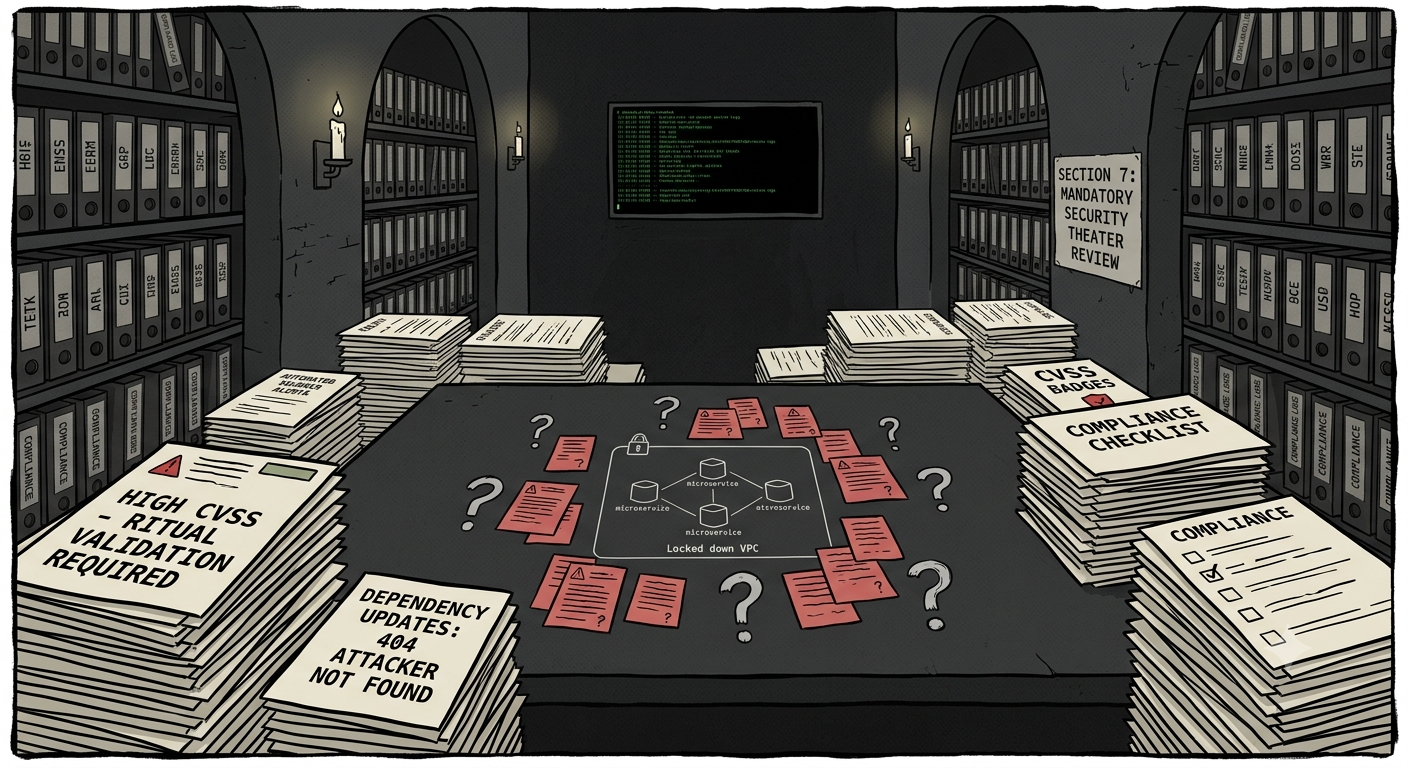
Different mouths, one noise: add more security, now. Not one of them showed me an attacker. Not one showed me the threat.
That’s the tell. A vulnerability is worth acting on when you can show the code that exploits it. The red banner, the CVSS score, the “we should really” line: all claims. Mostly marketing. Security you can’t justify becomes theater. Then it becomes a vicious cycle.
¶ Talk is cheap. Show me the code.1
A working proof of concept is proof. A severity score is a claim. A scanner label is a claim. Someone’s opinion is a claim. Claims are cheap. You can generate a thousand a day, no code required. The PoC is the tax that separates the real from the loud.
Watch a claim meet the tax. A hyped model scanned curl and reported five confirmed vulnerabilities; after the security team looked, one was real.2 The label said confirmed. The code said otherwise.
¶ Never update dependencies unless it breaks for your users.3
Brainlessly following automated-tool guidance is a security risk. Brainlessly adding a dependency to your code or infra is a security risk.
Supply chain: attackers force-pushed malicious commits to 75 of 76 tags of the official Trivy Action and turned it into a credential stealer.4 That proof never came from the red banner.
¶ Conclusion
None of this is anti-tooling. I keep the scanner and the model. The failure is treating a claim as a verdict: bad tool UI, plus blind obedience to decade-old compliance checklists.
So I’ve started to understand the projects that refuse AI contributions.
Linus Torvalds, linux-kernel mailing list, 25 August 2000. http://lkml.org/lkml/2000/8/25/132 ↩︎
Daniel Stenberg, “Mythos finds a curl vulnerability”, daniel.haxx.se, 2026-05-11. https://daniel.haxx.se/blog/2026/05/11/mythos-finds-a-curl-vulnerability/ ↩︎
Mitchell Hashimoto: “Fork your dependencies, trim them to only your use case, never update unless it breaks for your users.” https://x.com/mitchellh/status/2057171518027887035. ↩︎
Stephen Thoemmes, “Trivy GitHub Actions Supply Chain Compromise”, Snyk. https://snyk.io/articles/trivy-github-actions-supply-chain-compromise/ ↩︎