AI agent architecture: model, harness, intent
My VPS runs a “personal AI agent”. It forgets its own abilities every morning.
My terminal runs a coding agent. It ships production work.
Same year. Frontier models on both. Same ecosystem.
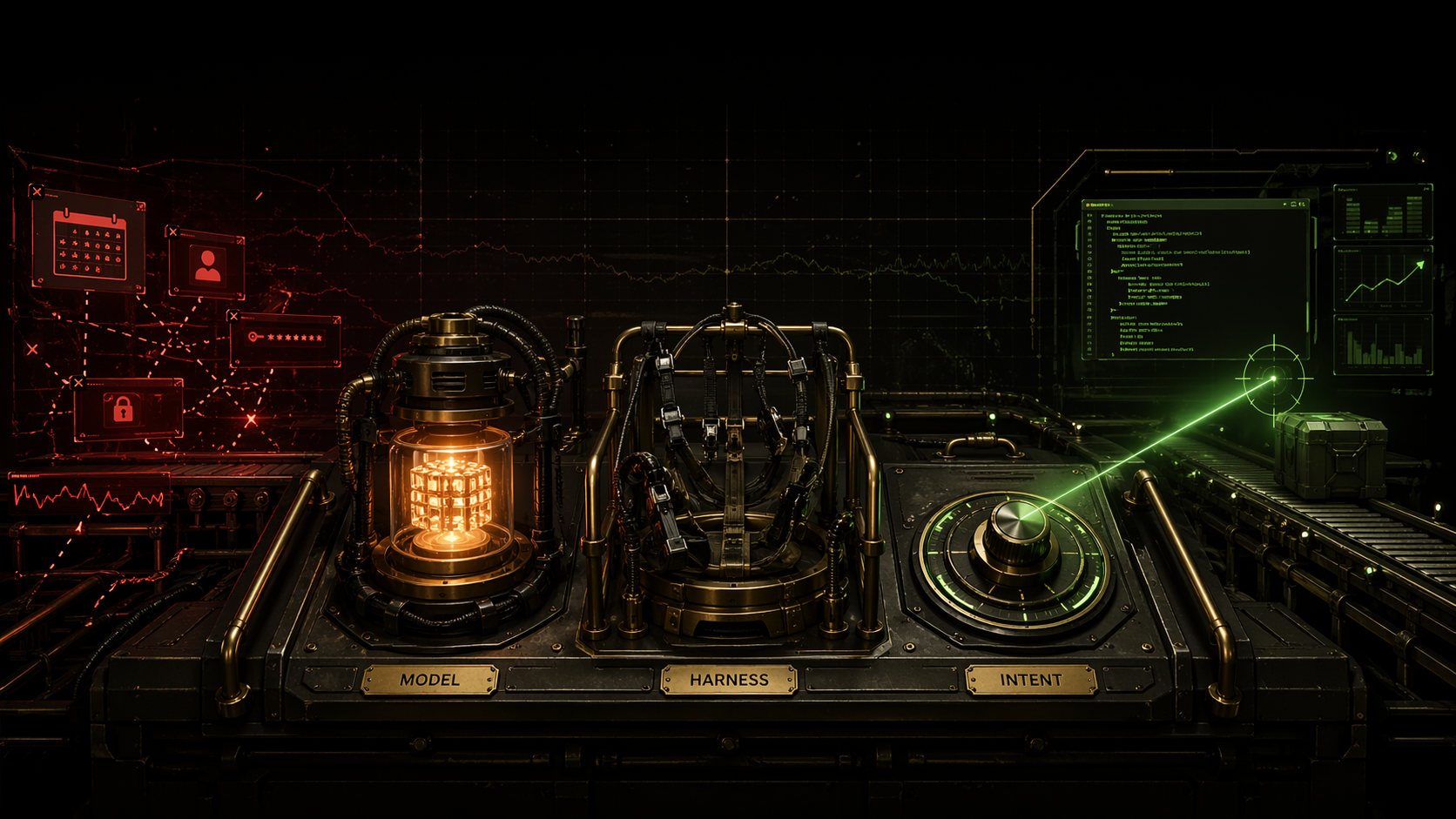
Both are model + harness, trying to handle the same thing: my intent. Why such a different experience? Start with the thing everyone mixes up: definitions.
# What is an AI agent?
- Anthropic: the company. Founded by ex-OpenAI researchers. Usual story.
- Claude: the model family. When someone says “ask Claude,” they usually mean a single call to whichever model through a chatbot. Competes with GPT (OpenAI) and Gemini (Google).
- Opus / Sonnet / Haiku: model tiers. Opus = most capable, Haiku = fastest / cheapest.
- Agentic approach / Agentic AI1: reason → act → observe → repeat, the loop itself; the loop is what makes something agentic.
- Agent: model wrapped in a harness, spins in a loop: reads context, plans,
acts, verifies, repeats. Distinct from a chatbot by execution pattern: a chat
interface can front an agent; a one-shot call cannot.
- Sub-Agent: execution thread inside an agent, inherits base settings, extends them.
- Agent harness2: everything in an AI agent except the model itself: tools, memory, workflow (the loop, plan/build sub-agents), guardrails (permissions, sandbox).
- MCP server: tool through which the agent interacts with the outer world: web, DBs, clouds, apps.
- Skill: goal-aimed prompt plus optional scripts, packaged capability.
- RAG: memory, agent stores custom data and pulls relevant chunks into context.
- AGENTS.md / CLAUDE.md / SOUL.md: custom instructions loaded into the context.
- Context: text the agent handles at once: user input, custom instructions, tool outputs, RAG-retrieved chunks. Bounded by the model’s context length.
Providers are wrapping yesterday’s chats in agent loops. Execution pattern flips, the chat UI stays. Same split still holds: model caps capability, harness wires integrations and workflow, and intent has to be decomposed into pieces the agent can handle. Who does the decomposition is the next question.
# AI platforms and architectures
First, split common LLM application architectures by workflow: the execution pattern around model calls.
At tiers 0-3 this is mostly application code: fixed calls, branching, one-off tool use. At tiers 4-5 it becomes an agent harness: loop, state, permissions, memory, orchestration.
Six tiers, in order of escalating cost/complexity:
| Tier | Pattern | When | Cost shape |
|---|---|---|---|
| 0 | Single prompt | Text in, text out | 1 LLM call |
| 1 | Prompt chain | Multi-step but predictable pipeline | N LLM calls |
| 2 | Routing | Input-type dispatch into one of K branches | Router call + selected branch |
| 3 | Tool-use, single round | Need external data, one tool round suffices | Tool schema tokens + tool call + synthesis |
| 4 | Agent, ReAct loop | Iterative, unknown depth, state-dependent | Unbounded: loop iterations × model/tool calls |
| 5 | Multi-agent / orchestrator | Long-horizon, decomposable, large context | Orchestrator + workers + replans + synthesis |
This post is about tiers 4 and 5: agent loops, orchestrators, and who owns intent decomposition.
Three families compete for “AI agent” today. Same lens for each: who owns intent decomposition? The specialized harness, the personal assistant, or me?
# Specialized AI agents
- AI trading agent
- AI legal assistant
- Customer service bot
- AI for medical diagnosis
Same product shape: narrow task, fixed workflow, integrations hidden behind the UI.
Perplexity is the research/search version of that shape.
Research the latest evidence and debate around emergent agency in AI systems in 2025-2026.
- Searching the web
- … some sources …
- Searching recent academic and policy sources on emergent agency in AI systems
- Retrieving recent reports and policy documents on AI agent behavior and emergent agency
Fine results, at least looks relevant.
what’s the model you using?
I’m Perplexity, powered by Grok 4.1. Perplexity’s default model is a custom-optimized version called Sonar, built on Llama 3.1 or later iterations like Llama 3.3 70B, fine-tuned for fast web search, summarization, and efficiency. It’s available to both free and Pro users for quick, relevant results. Pro subscribers can switch to advanced options like GPT-5.2 or Claude models via the model selector.
Fail. It understood the surface intent (answer a product-stack question), but the product owned routing and context. I had no way to inspect which model routed the answer, which metadata it saw, or why it mixed Grok, Sonar, and Llama into one pile.
The outcome: specialized harness frames intent into its fixed shape. When that frame fits, I get a clean research answer. When the frame itself is wrong, I get confident product salad and no useful control surface.
# Personal assistant
Tried OpenClaw first. It wants 2+ CPUs and 8+ GB RAM; my VPS has 1 and 1. Ran it anyway. It choked the VPS. Dropped it for Hermes.
Rarely discussed, but experimental software with a lot of external integrations has too broad an attack surface, see https://days-since-openclaw-cve.com. Keep it in mind.
# Hermes, an agent that grows with you
Strange that Nous Research doesn’t mention they have a Docker image,
docker.io/nousresearch/hermes-agent, which I’ve successfully set up in
podman.
/etc/containers/systemd/hermes-agent.container
[Unit]
Description=Hermes Agent
Wants=network-online.target
After=network-online.target

[Container]
Image=docker.io/nousresearch/hermes-agent:latest
ContainerName=hermes-agent
Network=selfhosted
Volume=/root/hermes:/opt/data
Volume=/root/hermes-root:/root
Volume=/tmp/hermes:/tmp
Ulimit=nofile=1024:1024

Environment=VIRTUAL_ENV=/root/.venv
Environment=PYTHONPATH=/root/.venv/lib/python3.13/site-packages

Exec=gateway run

[Service]
Restart=always
RestartSec=3
MemoryMax=768M
MemorySwapMax=768M
CPUQuota=85%
TasksMax=128

[Install]
WantedBy=multi-user.target
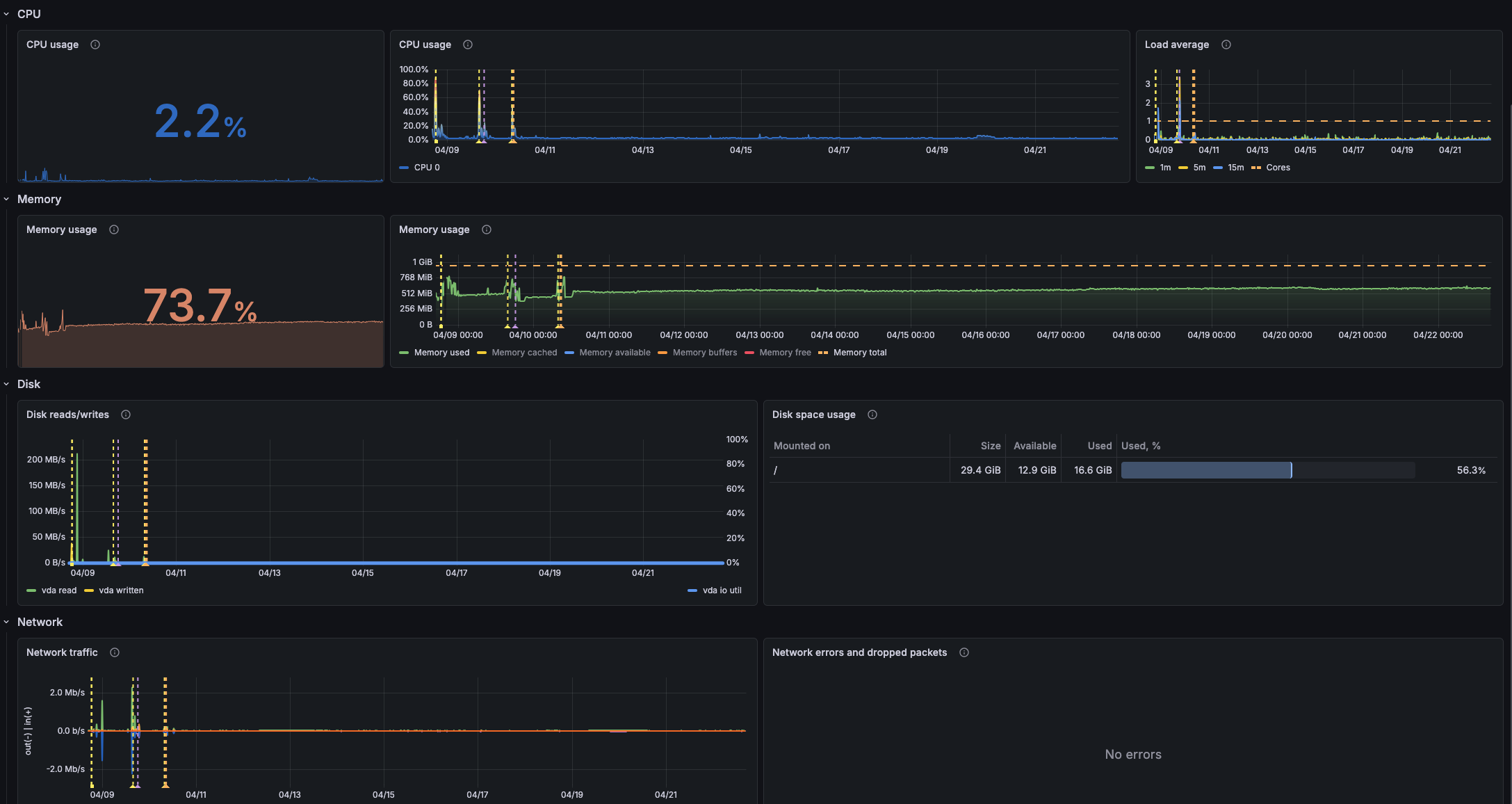
And it runs completely fine on a 1 CPU / 1 GB VPS.
CPU/RAM consumption
I connected it to my GPT subscription, added integrations for X, Google Calendar, Notion, and this blog’s RSS, plus free Mem0 as RAG.
It even worked right after setup, but the next day it forgot about the integration. I had to persuade it to try again.
OAuth failed in a different way. During Google Calendar integration I issued credentials only for read/write on the calendar, not broader Google scopes. The builtin Google skill wants broader access, so the agent re-requests broader scopes every time it touches the calendar, and eventually the auth flow breaks again.
One more case: I configured a scheduled job to check, each morning at 9:00, my Notion calendar, Google Calendar, event listings, and send me a summary for today and tomorrow. How often does it work right? Almost never. It checks only one calendar, sends events for the next ~6 months instead of 2 days, sends events for the current month but from this and previous years, and so on.
Current state: the initial GPT auth token has expired, and the agent can’t renew it automatically. Well… experiment successful.
Each failure is easy to fix manually: cron, small script, explicit OAuth scopes, date windows, deterministic calendar queries. But that is exactly the point: the general assistant is supposed to replace the glue. Here it doesn’t. The failure is not the model. The harness decomposes intent badly, and the UI doesn’t expose decomposition early enough to fix it.3
# CLI coding agents
Terminal-native, actively evolving. Everything in my hands. Only vendor ToS can limit me.
# OpenCode, the open source AI coding agent
My favorite one. Open source, standard ~/.config/opencode path, strong
build/plan sub-agent architecture. Also ships opencode web, same engine,
browser UI.
~/.config/opencode/opencode.jsonc
{
  "$schema": "https://opencode.ai/config.json",
  "autoupdate": false,
  "default_agent": "plan",
  "share": "disabled",
  "snapshot": false,
  "instructions": ["/Users/ivan/.config/opencode/AGENTS.md"],
  "mcp": {
    "context7": {
      "type": "remote",
      "url": "https://mcp.context7.com/mcp",
      "headers": {
        "CONTEXT7_API_KEY": "{env:CONTEXT7_API_KEY}"
      },
      "enabled": true
    },
    "playwright": {
      "type": "local",
      "command": [
        "npx",
        "-y",
        "@playwright/mcp@latest",
        "--browser=chromium",
        "--executable-path=/Applications/Chromium.app/Contents/MacOS/Chromium",
        "--caps=vision,devtools"
      ],
      "environment": {
        "PLAYWRIGHT_BROWSERS_PATH": "{env:HOME}/.cache/ms-playwright"
      },
      "enabled": true
    }
  },
  "experimental": {
    "openTelemetry": false
  },
  "server": {
    "mdns": false
  },
  "plugin": []
}
Current AI-bro consensus: “Context is the key”. I agree. Context engineering pwnd prompt engineering.
Even more, after Gloaguen et al., “Evaluating AGENTS.md” (Feb 2026), generated agent context files hurt task success and add ~20% inference cost. I stopped keeping per-repo CLAUDE.md / AGENTS.md files full of paths, framework summaries, and obvious project descriptions. Current agents can inspect a repo per case, fast and cheap enough. Put only what they cannot infer from code: constraints, preferences, dangerous commands, external contracts.
my global CLAUDE.md / AGENTS.md
# Invariants

Hold every turn. Violations get surfaced, not smoothed, mine or yours.

No assumption is used before it's stated. No contradiction is averaged; both
sides framed, one chosen. No implementation starts before its measurable outcome
exists. No clever where simple works. No reply over 1024 chars unless asked to
expand.

## Environment

Absent: `gh`. Forbidden: `rm`, `curl`, `git add`, `git commit`. Search: `rg`.
...
Still, the most reliable way to fix hallucinations is not to argue with the agent but to drop the session and restart from scratch.
OpenCode’s approach helps me clearly follow the principles above:
- In plan mode I explain the goal and constraints, pointing to important files or docs as entry points;
- The plan sub-agent collects requirements, explores the repo, clarifies intent, produces a plan4;
- I review the plan; if decomposition is wrong, GOTO 1;
- The approved plan is handed to the build sub-agent, which implements it5;
- GOTO 1.
In plan mode, the harness exposes decomposition before execution. At that point, the limit is me: how clearly I can split intent into steps.
This resembles the Plan-Then-Execute pattern6.
# Claude Code
I migrated Claude work to Claude Code after Anthropic restricted third-party Claude access to API credits7; OpenCode still runs my GPT subscription.
Proprietary, vendor-locked, but I can’t complain that it misses anything important.
~/.claude/settings.json
{
  "$schema": "https://json.schemastore.org/claude-code-settings.json",
  "env": {
    "CLAUDE_CODE_DISABLE_FEEDBACK_SURVEY": "1",
    "CLAUDE_CODE_DISABLE_NONESSENTIAL_TRAFFIC": "1",
    "DISABLE_ERROR_REPORTING": "1",
    "DISABLE_FEEDBACK_COMMAND": "1",
    "DISABLE_TELEMETRY": "1"
  },
  "permissions": {
    "allow": [
      "Bash(git log *)",
      "Bash(git diff *)",
      "Bash(git show *)",
      "Bash(git status)",
      "Bash(grep *)",
      "Bash(echo *)",
      "Bash(ls *)",
      "Bash(rg *)",
      "Bash(npm run *)",
      "Bash(npm test *)"
    ],
    "deny": [
      "Bash(curl *)",
      "Bash(docker push *)",
      "Bash(find * -delete)",
      "Bash(find * -exec rm*)",
      "Bash(git branch -D *)",
      "Bash(git checkout -- *)",
      "Bash(git clean -f*)",
      "Bash(git push *)",
      "Bash(git reset --hard*)",
      "Bash(nc *)",
      "Bash(rm -f *)",
      "Bash(rm -r *)",
      "Bash(rm -rf *)",
      "Bash(rsync *)",
      "Bash(scp *)",
      "Bash(ssh *)",
      "Bash(sudo *)",
      "Bash(wget *)",
      "Edit(./.env*)",
      "Edit(./.git/**)",
      "Edit(./secrets/**)",
      "Edit(~/.aws/**)",
      "Edit(~/.bashrc)",
      "Edit(~/.ssh/**)",
      "Edit(~/.zshrc)",
      "Read(*.env)",
      "Read(./.env.*)",
      "Read(./secrets/**)",
      "Read(~/.aws/**)",
      "Read(~/.azure/**)",
      "Read(~/.config/gh/**)",
      "Read(~/.git-credentials)",
      "Read(~/.gnupg/**)",
      "Read(~/.kube/**)",
      "Read(~/.npmrc)",
      "Read(~/.ssh/**)"
    ],
    "defaultMode": "plan"
  },
  "enabledPlugins": {
    "security-guidance@claude-plugins-official": true,
    "frontend-design@claude-plugins-official": true,
    "mattpocock-skills@mattpocock": true
  },
  "extraKnownMarketplaces": {
    "mattpocock": {
      "source": {
        "source": "github",
        "repo": "mattpocock/skills"
      }
    }
  },
  "sandbox": {
    "enabled": true,
    "excludedCommands": ["git"]
  },
  "autoUpdatesChannel": "stable",
  "awaySummaryEnabled": false,
  "disableArtifact": true,
  "disableAutoMode": "disable",
  "disableBundledSkills": true,
  "disableClaudeAiConnectors": true,
  "disableRemoteControl": true,
  "disableWorkflows": true,
  "effortLevel": "high",
  "skipAutoPermissionPrompt": false,
  "theme": "light"
}
This config reaches the same control goal I like in OpenCode: decomposition stays visible, writes stay gated, mode switching stays under my control:
"defaultMode": "plan": plan mode by default: writes blocked, reads allowed, plan exposed as/plan"disableAutoMode": "disable": no autonomous mode switching"sandbox.enabled": trueplus apermissions.denylist forrm -rf,git push,sudo,~/.ssh/**, etc.- telemetry off:
DISABLE_TELEMETRY=1,DISABLE_FEEDBACK_COMMAND=1,DISABLE_ERROR_REPORTING=1,awaySummaryEnabled: false
# Current setup
- Context7 MCP: provides actual library docs instead of the model’s stale or hallucinated snippets.
- Playwright MCP: browser control. Nothing else to add.8
Caveman plugin: its selling point is “Saves tokens, preserve accuracy”.9- security-guidance@claude-plugins-official: blame the times
Each of these touches the harness only. Model stays the vendor’s, intent stays mine.
# Intent is the failure point
Perplexity frames intent into its fixed shape. Hermes decomposes intent on its own, without me. CLI plan mode keeps decomposition visible. I’m the bottleneck.
The loop is what makes something agentic, and the harness puts me inside or outside of it.
- Outside the loop: I wait for a solution that fits my intent’s shape. When it doesn’t, the agent won’t say “no”. It attempts the task anyway, drifts, and hands something back.
- Inside the loop: I keep intent, decompose it, approve execution. The ceiling is whatever I can break into steps.
Same year. Same frontier models. Humans still hold the loop. That is the autonomy that emerges today.10
Popularized by ReAct: Yao et al., ICLR 2023 (paper, Google Research blog). ↩︎
See Birgitta Böckeler, “Harness engineering for coding agent users”: https://martinfowler.com/articles/harness-engineering.html. ↩︎
Personal assistants still look worth watching. I’ll wait for the next Hermes iteration. Notion’s agent may become the boring alternative. ↩︎
Yes-yes, I know about openspec.dev, but the plan has to stay observable, not 5+ A4 neuro-generated pages of raw text. ↩︎
To save some tokens I use stronger model for plan (Opus) and weaker for build (Sonnet). ↩︎
https://simonwillison.net/2025/Jun/13/prompt-injection-design-patterns/#the-plan-then-execute-pattern Caveat: the split is weaker here. Plan sub-agent still reads untrusted repo while planning, so a malicious file can steer the plan. ↩︎
Anthropic tightened terms. Subscription plans (including the corporate one I use) no longer cover Claude access from third-party apps; third-party access now requires per-usage API credits. ↩︎
CLI is more token effective than MCP, https://github.com/microsoft/playwright-cli#playwright-cli-vs-playwright-mcp. ↩︎
Caveman vs “be brief”, https://www.maxtaylor.me/articles/i-benchmarked-caveman-against-two-words. Agent tools move too fast; without a fresh benchmark after model or harness updates, a third-party skill can quietly make results worse than the baseline. Benchmark it continuously or keep it off. ↩︎
Agent autonomy framed as emergent from model behavior, product design, and user oversight strategy. ↩︎